

From design files to long-term durability on the water
Wingfoil wings may look simple from the outside, but how they are designed and built has a direct impact on how they perform, how consistent they feel, and how long they last in real conditions.
This article explains, step by step, how a wingfoil wing is designed, constructed and inspected, focusing on process, control and repeatability rather than on a specific product.
The goal is not to sell a model, but to explain what actually matters when building a wing meant to be used regularly over time.
1. Design comes before production
Every wing starts as a design, not as a production target.
Before any material is cut, the wing is fully defined in a digital environment. Aerodynamic profiles, panel geometry, twist distribution and structural load paths are developed using CAD and 3D design workflows. As in advanced sailmaking and aeronautical structures, the objective is not only to define a shape, but to define how that shape behaves under load, how it reacts to gusts, and how it recovers when pressure is released.
Stable handling is never the result of a single feature. It is the result of many small, interconnected decisions: profile depth, draft position, twist distribution, panel layout, seam placement, reinforcement geometry and fabric orientation. If any of these elements is vague or inconsistent, the wing may still fly, but it will not feel predictable or repeatable.
Design clarity is critical because production consistency depends on it. A factory does not correct a design. It executes it. If the digital design is unstable, ambiguous or constantly changing, no level of craftsmanship can compensate for that later.

For this reason, designs are refined over time rather than replaced every few months. Refinement improves repeatability, tightens tolerances and allows smooth scaling between sizes, so a 3.5 and a 5.0 behave like members of the same family, not like different products.
2. Materials and their real role
Material choice is often simplified to weight alone, but long-term performance depends on how materials behave over time.
In sailmaking and aerospace structures, materials are selected for dimensional stability, fatigue resistance and consistency between batches, not only for how they feel when new. The same applies to wings. A fabric can feel light and crisp on day one, but if it relaxes, creeps or loses stability under repeated load cycles, the wing gradually changes its behavior.
Material selection therefore focuses on predictable performance over thousands of load cycles, including exposure to UV, heat, salt and handling.
Fabric orientation is equally critical. Warp and weft directions have very different stretch characteristics. Panel orientation is used to control how the canopy holds its profile, how twist develops under load, and how the trailing edge behaves as the wing ages. This is not cosmetic. It is structural and aerodynamic at the same time.
3. Cutting and preparation
Once materials are defined, precision moves from the screen to the cutting stage.
Panels are cut using calibrated CAD CAM cutting systems. Plotters are regularly checked and adjusted so digital patterns translate accurately into physical components. Small deviations at this stage do not disappear later. They accumulate.
In aerodynamic structures, symmetry is not a visual preference. It is a functional requirement. Small left-right deviations can introduce uneven loading, making a wing feel different on each tack or during transitions.
Preparation is part of accuracy. Cut parts are labeled, organized and sequenced so assembly follows the exact structural logic defined during design. This reduces human error and prevents tolerance stacking, where small inconsistencies at each step become a measurable deviation in the final wing.
4. Sewing and structural assembly
Sewing is where digital design becomes a physical structure.
At this stage, attention to detail becomes non-negotiable. Seam alignment, stitching tension and assembly sequence all influence how closely the finished wing matches the intended 3D shape.
As in sailmaking, even millimeter-level differences in seam position or panel tension can alter profile depth and twist. The designed geometry is only preserved if seams are placed accurately, tensions are controlled and the process is repeatable.
Reinforcements are integrated according to load paths defined during design. They are not decorative. Their size, placement and orientation determine how loads are distributed and how the wing evolves over time.
Experienced hands are critical here, not for speed, but for consistency. Repeatability is what allows one wing to feel like the next.
5. Integration of leading edge and struts
The leading edge and struts form the primary structural frame of the wing.
From an engineering perspective, they function like spars in aeronautical structures. If alignment is off, inflation pressure does not support the intended shape, it distorts it. If attachment points are misplaced or insufficiently reinforced, canopy tension becomes uneven.
During assembly, alignment between inflatable structures and canopy is carefully controlled, attachment points follow defined load paths, and tolerances are verified before final closure. This ensures that internal pressure translates into stiffness and shape stability, not unwanted deformation.
6. Quality control during production
Quality control is not a final step. It is a continuous process.
Checks are performed throughout production to verify that digital design intent is being respected. Panel alignment, seam accuracy, symmetry, reinforcement placement and high-load areas are inspected at multiple stages.
This level of control requires total attention to even the smallest details. Without it, consistency from wing to wing is not achievable. Quality here is not a slogan. It is a system.
Any deviation is corrected immediately or removed from the process, preventing small inaccuracies from becoming structural problems later.
7. Final inspection and inflation test
Before packing, each wing goes through a final inspection.
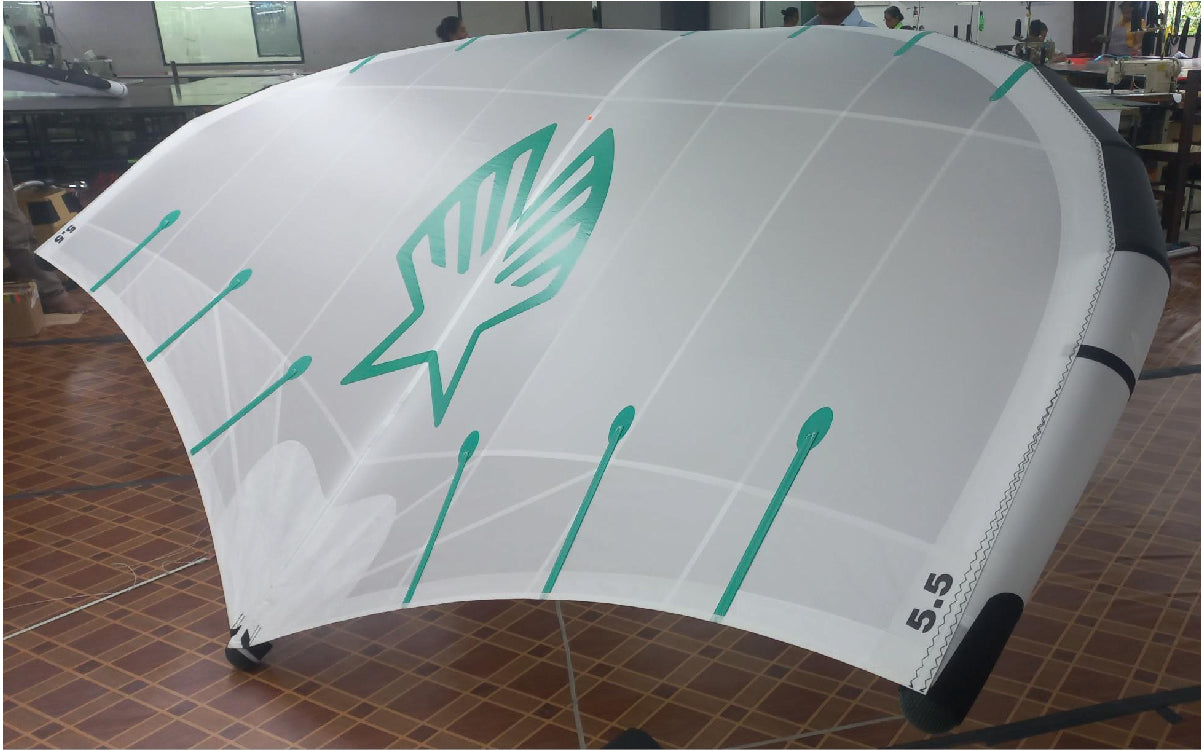
The wing is fully inflated, overall shape and symmetry are checked, and seams and attachments are reviewed. This step does not test performance. It confirms that the wing matches the original digital design and construction standards.
Only after passing this stage is the wing prepared for packing.
8. Why this process matters on the water
The way a wing is designed and built directly affects how stable it feels, how predictable it behaves and how long it maintains its intended shape.
Consistency in digital design, cutting accuracy, structural assembly and quality control leads to consistency on the water. A rider should not need to adapt to production variability.
Durability is not a single feature. It is the result of many small decisions executed correctly, from CAD design and fabric orientation to cutting calibration, seam accuracy and final inspection.
9. From digital design to the water
Building a wingfoil wing is a controlled workflow where every step depends on the one before it. Consistency is not achieved through one single feature, but through the alignment of design, tools, processes and attention to detail.
design and simulation
aerodynamic profiles, panel layout, load paths and twist distribution are defined using CAD and 3D design tools
digital patterns and calibration
design files are translated into production patterns, with tolerances defined and cutting systems calibrated to match the digital geometry
cutting and preparation
panels are cut using CAD CAM systems, labeled and sequenced to preserve symmetry and prevent tolerance stacking
structural assembly
panels, seams and reinforcements are assembled following defined load paths, with controlled tension and repeatable processes
quality control
alignment, symmetry, seams and high-load areas are checked throughout production, not only at the end
final inspection and validation
each wing is inflated, inspected and verified against the original design intent before packing

10. A long-term view on construction
Building wingfoil wings is not about speed or volume. It is about control and consistency over time.
Design software, calibrated cutting systems, disciplined assembly processes and rigorous quality control all work together. When they are aligned, the result is a wing that performs as intended not only when new, but after many sessions in real conditions.
That level of attention to even the smallest detail is not optional. Without it, consistent performance and long-term durability are simply not possible.
This way of building wings only works when design intent, production tools and quality control are fully aligned.
To see how this philosophy is applied day to day, you can explore our Factory, where the construction process takes place, and our Ezzy Approach, which explains the design principles and long-term thinking behind every wing we build.


