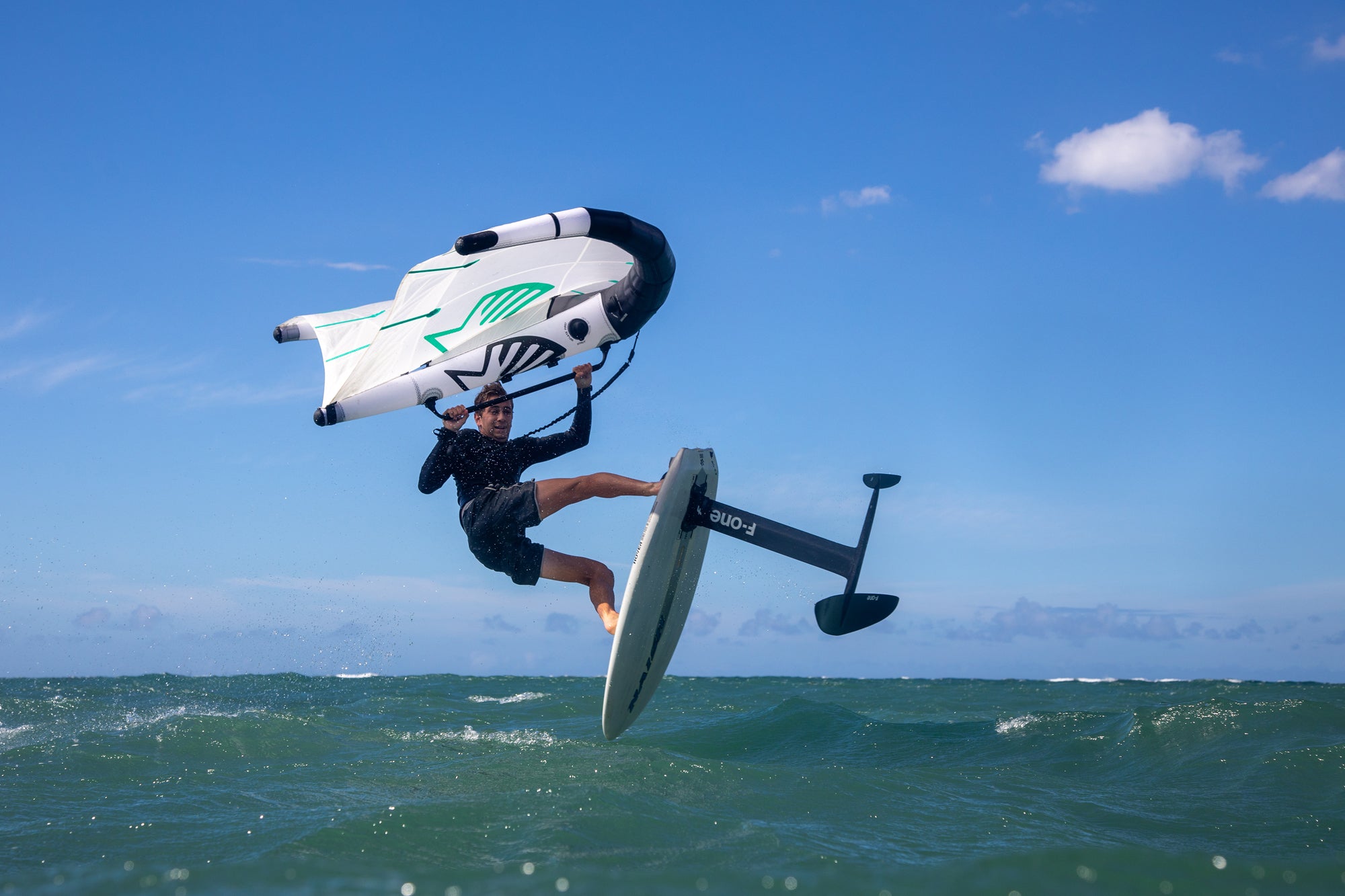


Which One Should You Actually Choose?
One of the biggest debates in wing foiling today isn't about foils or boards—it's about how you hold the damn thing.
Should you ride with soft handles, rigid handles, or a boom?
Here's the truth: all three work. But they feel completely different on the water, and choosing the wrong one can hold back your progression or make sessions way more tiring than they need to be.
Let's break it down the way it actually is, not the way marketing teams want you to think it is.
What Are Wing Handles and Booms Anyway?
If you're new to wing foiling, here's the quick version:
Soft handles are made from webbing or fabric. They're flexible, light, and usually sewn into fixed positions on the wing.
Rigid handles have a stiff core (usually EVA foam over a hard insert). They give more direct feel than soft handles but still lock you into specific hand positions.
Booms run along the entire strut, giving you continuous grip anywhere you want—just like a windsurf boom.
All of them let you control the wing. But the experience is night and day different.
Soft Handles: Simple, Light, and Limited
Soft handles are what most beginner and freeride wings come with. They're comfortable, forgiving, and cheap to make.
The good:
- Very light weight
- Comfortable on your hands for long sessions
- Simple—no extra parts to think about
- Durable if built well
The not-so-good:
- Less direct control, especially when powered up
- Fixed hand positions make transitions awkward
- Can feel vague or disconnected in stronger wind
- Hard to adjust grip for different moves
Real talk: Soft handles are great when you're learning or cruising in light wind. But most riders hit a wall with them once they start pushing harder, jibing faster, or riding waves.
You end up fighting the wing instead of flowing with it.
Rigid Handles: More Control, Still Limiting
Rigid handles are the middle ground. They give you better power transfer than soft handles without going full boom.
The good:
- More precise feel than soft handles
- Better control when the wing loads up
- Familiar for riders coming from kiting
- Still relatively light
The not-so-good:
- You're still locked into fixed positions
- Can feel restrictive during transitions
- Usually sized for specific hand widths
- Doesn't give you room to experiment with grip
Real talk: Rigid handles are a step up from soft, but you're still working around the handles instead of moving naturally with the wing.
If you're serious about progression, you'll probably outgrow them.
Boom: Maximum Freedom, Natural Control
A boom changes everything.
Instead of fixed handle positions, you get continuous grip along the entire strut. Your hands go wherever they need to be—just like riding a windsurfer.
The good:
- Unlimited hand positioning anywhere on the boom
- Way more precise control in all conditions
- Transitions (jibes, tacks) feel way more natural
- One-handed riding is easy and stable
- Perfect for freestyle tricks and wave riding
- Your body adapts to the conditions instead of adapting to the handles
The not-so-good:
- Slightly heavier than handles (but not much)
- One extra piece to manage
- Usually costs more upfront
Real talk: Most riders who switch to a boom never go back. Once you feel the freedom of moving your hands naturally instead of hunting for the right handle, it's hard to ride anything else.
How Your Grip System Actually Affects Your Riding
This isn't just about comfort. Your grip system directly impacts:
- Power control: How easily you can dump or load power on demand
- Transitions: How smooth your jibes and tacks feel
- One-handed riding: How stable the wing is when you're riding waves or doing tricks
- Body positioning: Whether you adjust your grip to the conditions, or force your body into awkward positions
- Fatigue: How tired your hands and forearms get during long sessions
With handles, you adapt your body to fixed positions.
With a boom, you move your hands naturally and your body stays efficient.
That's the real difference.
What Works for Different Skill Levels?
Beginners
Soft or rigid handles can feel easier at first—less to think about, lighter feel.
But plenty of beginners start with booms and adapt just fine. The natural hand movement actually makes learning easier for some people.
Intermediate riders
This is where handles start to hold you back. You're pushing harder, riding in stronger wind, working on transitions—and fixed handles feel limiting.
Boom starts making way more sense.
Advanced riders
Almost everyone at this level rides booms. Freestyle, wave riding, aggressive freeride—boom gives you the control and freedom you need.
Bottom line: Don't assume soft handles are "beginner" and booms are "advanced." It's more about riding style than skill level.
Durability: What Actually Holds Up
Handles and booms take serious abuse—constant load, UV exposure, saltwater, crashes.
Here's what to look for:
For handles:
- Reinforced stitching at attachment points
- Strong webbing that won't stretch
- Sealed or protected cores (rigid handles)
For booms:
- Stiff construction that doesn't flex under load
- Corrosion-resistant hardware
- Comfortable grip texture
- Solid mounting system to the strut
A good boom should feel bomber—not flexy, not creaky, not fragile. If it feels cheap, it probably is.
So Which One Should You Choose?
There's no universal right answer, but here's the honest breakdown:
Choose soft handles if:
- You're cruising in light wind and value simplicity above all
- Weight is your absolute top priority
- You're on a tight budget
Choose rigid handles if:
- You want better control than soft handles without committing to a boom
- You're coming from kiting and want something familiar
- You ride in moderate conditions
Choose a boom if:
- You want maximum control and freedom
- You do a lot of transitions, wave riding, or freestyle
- You value natural hand movement over fixed positions
- You're serious about long-term progression
Why We Build for Boom Control
At Ezzy, we've been designing sails for decades. We've seen what works and what doesn't.
From our experience, the boom is the natural evolution for wing control.
Here's why:
- Better power management: You can fine-tune exactly where and how you grip
- Natural movement: Your hands go where they need to be, not where handles force them
- Smoother riding: Transitions, jibes, wave riding—everything flows better
- Long-term comfort: Less strain on your hands and wrists
That's why the Ezzy Flight Wing is designed around boom control from the start. Not as an add-on or afterthought—built into the design.
We're not saying handles don't work. We're saying if you want the most control, the most freedom, and the most natural feel, boom is the way.
The Real Test: Try Before You Decide
If you can, demo different setups. Borrow a friend's wing. Rent from a shop.
What feels right in your hands matters more than any spec sheet.
The best grip system is the one that makes your riding feel easier, more intuitive, and more fun.
For most riders pushing their progression, that's a boom.
Looking for a wing built around boom control?
Check out the Ezzy Flight Wing—designed for precision, balance, and real-world performance.
More resources: